New data released today by the National Centre for Vocational Education Research (NCVER) shows that Australia’s government-funded vocational education and training (VET) sector continues to remain relatively stable, despite fluctuations in student enrolments across states and territories in 2024.
The 2024 figures suggest a return to more stable, longer-term trends in student enrolments, following a spike in 2023. Overall student enrolments remain higher than pre-pandemic levels in 2019, indicating ongoing strong engagement with government-funded VET nationwide.
According to the Government-funded students and courses 2024 report, student numbers decreased to 1.2 million in 2024, down 2.6% from the previous year. Despite this overall decline, three states recorded increases: Western Australia rose by 5.2%, Queensland by 2.6% and Victoria by 0.9%. In contrast, the remaining jurisdictions experienced declines: Australian Capital Territory dropped by 16.2%, New South Wales by 9.5%, Northern Territory by 7.8%, Tasmania by 5.5% and South Australia by 0.5%.
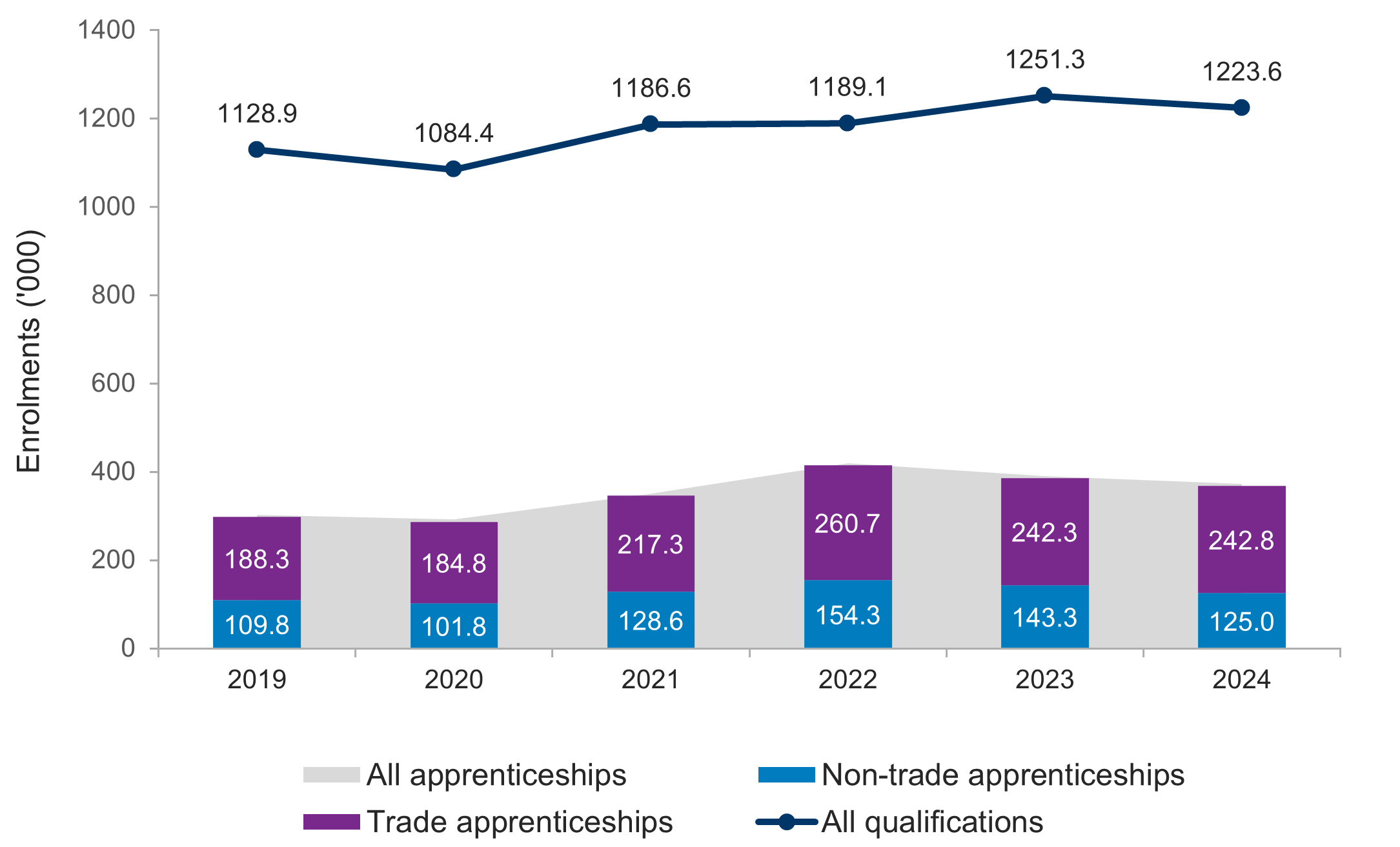
While variation in enrolments across the different types of government-funded training is evident, the number of students enrolled in qualifications – the largest component of government-funded training – remained high at 1.07 million in 2024, up from 968,095 in 2019 but down marginally from 2023, following an increase of 7.2% between 2022 and 2023.
Non-trade apprenticeships were a large contributor to the national decline in government-funded qualification enrolments. Although apprenticeships represent around one third of all qualification enrolments, they accounted for more than half of the overall decrease from 2023. This trend is likely linked to the conclusion of key incentive programs and the transition towards state-based priorities and Fee-Free TAFE.
Figure 1: Government-funded qualification enrolments, including apprenticeships, 2019-24
NCVER Managing Director John King said, ‘In 2024, we observed a continued shift in the makeup of government-funded VET as jurisdictions rebalance priorities. There has been a notable move from Australian Government employer-focused incentive programs towards initiatives like Fee-Free TAFE.
‘The 2024 data highlights how regional differences are shaping enrolment trends, as each jurisdiction responds to local skill shortages and priorities.
‘What’s particularly encouraging is that enrolments in training package qualifications have remained strong. The data indicates that ongoing government efforts may be helping to drive enrolments into areas of national priority,’ said Mr King.
Figure 2: Training package qualifications enrolments with the largest absolute change between 2023 and 2024
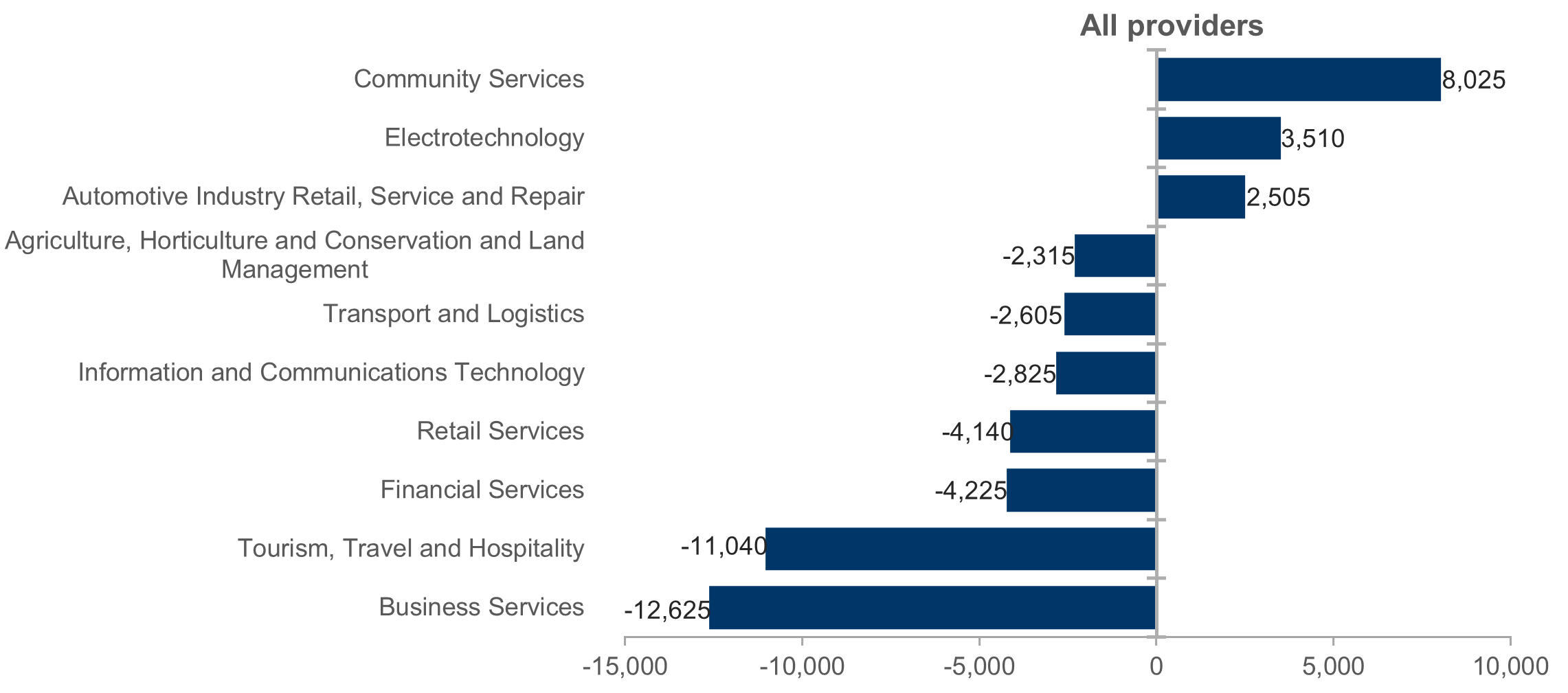
Although government-funded VET enrolments have decreased, training package completions continue to grow, increasing by 19,620 (6.2%) between 2023 and 2024. This growth was particularly evident in Community Services, and Construction, Plumbing and Services training packages.
Background:
Government-funded students and courses 2024 provides information on the number and characteristics of students undertaking government-funded VET in Australia during the year.
Download the report: Government-funded students and courses 2024
Enquiries: Tari Wagland P: +61 8 8230 8464 E: tariwagland@ncver.edu.au
About NCVER: we are the main provider of research, statistics and data on Australia’s VET sector. Our services help promote better understanding of VET and assist policy makers, practitioners, industry, training providers, and students to make informed decisions.
This work has been produced by NCVER on behalf of the Australian Government and state and territory governments, with funding provided through the Australian Government Department of Employment and Workplace Relations.