
The National Centre for Vocational Education Research (NCVER) has released its latest data showing continued growth in the number of students enrolled in nationally recognised training across Australia.
In 2024, 5.1 million students undertook some form of training, representing a 1.8% increase from 2023 and the highest level since the collection began in 2015.
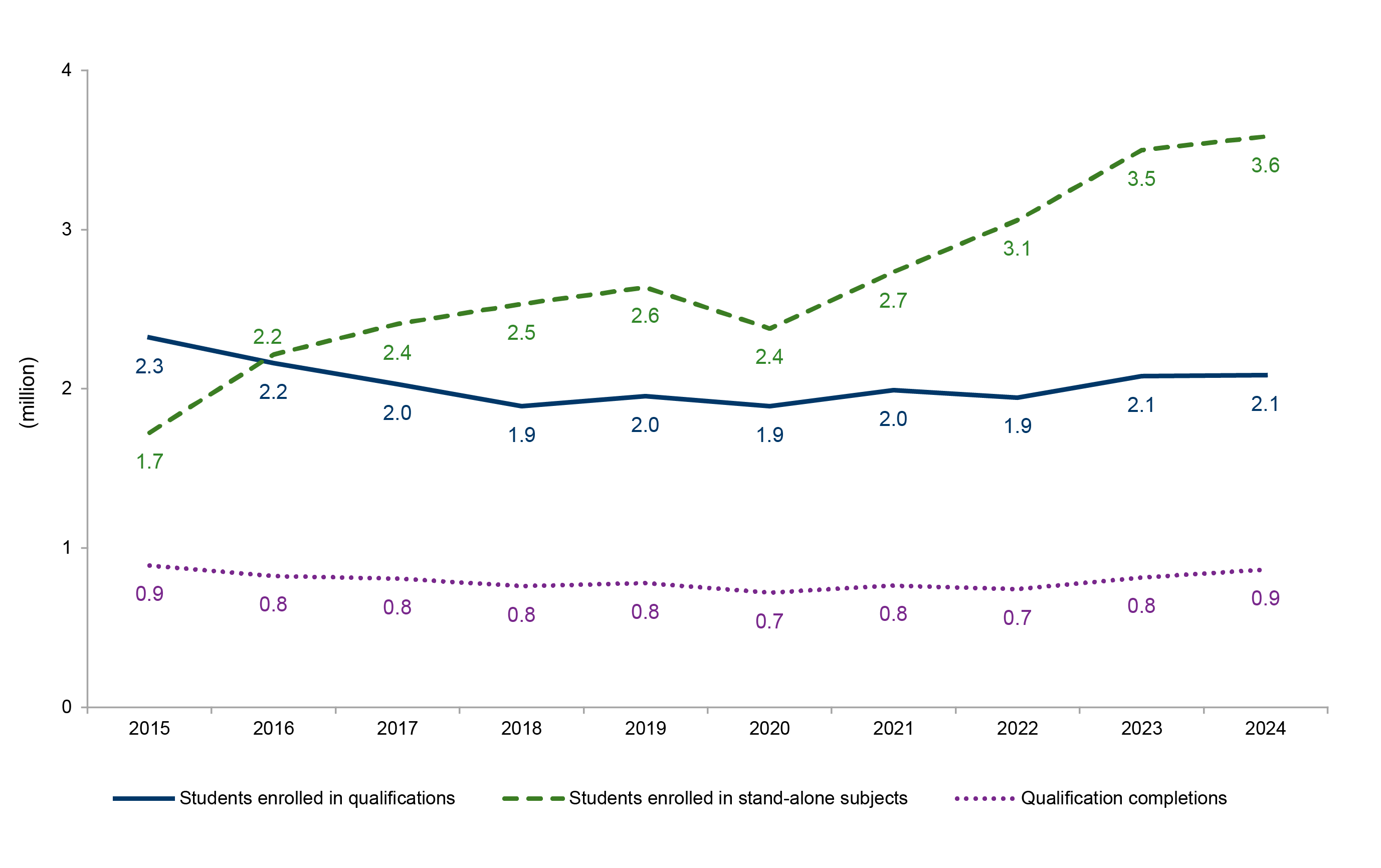
While the number of students enrolled in qualifications remains strong, and largely unchanged from the previous year following the first tranche of Fee-Free TAFE programs, nearly two-thirds (69.9%), or 3.6 million students, undertook stand-alone subjects.
The upward trajectory of stand-alone subjects continued, with a 35.9% increase since 2019. The most popular are compliance and workplace-mandatory subjects, primarily in health-related areas, such as cardiopulmonary resuscitation (CPR) and First Aid, and workforce preparation for the construction industry. Growth in these areas may be linked to increased employment within Health Care and Social Assistance and Construction industries in recent years.
NCVER Managing Director John King said, ‘The VET sector plays an important role in developing new skills and knowledge for individuals to enter employment, and also in the ongoing skills maintenance of the existing workforce.’
The Community Services training package remained the most popular qualification, with enrolments increasing by 3.3% from 2023. Qualifications in Early Childhood Education and Care and Individual Support were the main contributors to the increase in the last year, both critical for addressing skills shortages in health care and social assistance.
The mix of qualification levels is shifting over time towards higher-level study, in line with changing workforce demands. This change is helped by the reallocation of government funding away from entry-level certificate I and II qualifications towards certificates III and IV, coupled with strong growth in international enrolments in higher-level qualifications, particularly at the diploma and above level.
Qualification completions have gradually increased to the highest level in nine years. The rise in completions over the last year was predominantly in Tourism, Travel and Hospitality (largely driven by growth among international full-fee-paying students), Business Services and Community Services.
Figure 1 Students enrolled in qualifications and stand-alone subjects, and qualification completions, 2015-2024
NCVER Managing Director, John King, states "with the ability to adapt to changing labour market demands, VET plays a central role in addressing skill shortages across priority sectors such as construction and care, while also creating accessible training for Australians at different stages of their careers. Spanning both entry-level and advanced qualifications, VET ensures a pipeline of skilled workers that can meet emerging national priorities.”
Looking at the makeup of VET student engagement in 2024:
- Domestic government-funded student enrolments in qualifications were steady at 1.2 million, but enrolments in short courses and stand-alone subjects fell from 2023 due to shifts in government funding priorities.
- Growth in domestic fee-paying training was driven by student enrolments in stand-alone subjects (up 3.6%), while enrolments in qualifications declined from the previous year.
- International fee-paying student enrolments in qualifications grew strongly, particularly at the diploma and above level, with sharp declines in stand-alone subject enrolments from 2023.
“VET’s flexibility not only meets changing labour market demands but also strengthens Australia’s workforce, underpinning economic growth and ensuring the nation is prepared for emerging challenges,” said Mr King.
Background
Total VET students and courses 2024 reports the number of students and enrolments in nationally recognised VET on a government-funded or fee-for-service basis, noting many students enrol in more than one type of training.
This publication provides an estimate of the extent and nature of nationally recognised vocational education and training (VET) delivered in 2024 by Australian registered training providers (RTOs). Vocational education and training by nature is diverse, spanning a wide range of learning engagements from full-time programs across multiple years, short courses, to stand-alone subjects that were not delivered as part of a nationally recognised program. Student participation can also be wide ranging, with some students receiving training from multiple training providers within the same year.
Download the report Total VET student and courses 2004.
Enquiries: Tari Wagland P: +61 8 8230 8464 E: Communications@ncver.edu.au
About NCVER: we are the main provider of research, statistics and data on Australia’s VET sector. Our services help promote better understanding of VET and assist policy makers, practitioners, industry, training providers, and students to make informed decisions.
This work has been produced by NCVER on behalf of the Australian Government and state and territory governments, with funding provided through the Australian Government Department of Employment and Workplace Relations.